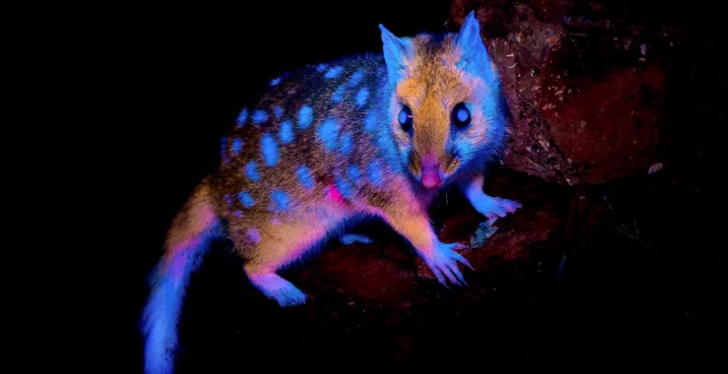
Somehow, this glowing marsupial is rarely seen, despite being glow-in-the-dark. But a photographer has managed to capture the fuzzy little guy using ultraviolet light.
The photo of the glow-in-the-dark marsupial is the first of its kind. They are notoriously hard to spot, and capturing them actually glowing is even rarer. To the naked eye, the bioflorecence isn’t visible. However, the ultraviolet light employed in the photographer’s camera makes it shine through the night.
Ben Alldridge submitted his photo of the wild Eastern quoll at the 2025 Beaker Street Science Photography Prize. Judges were delighted to see the glowing fur on the small marsupial. “Where their fur is normally fawn or black, under certain wavelengths of light, they exhibit a process referred to as biofluorescence — like nature’s version of a white shirt glowing at a disco,” the photographer told The Daily Mail.
This is considered the first successful photo of a glowing marsupial. As a result, it will become a core piece of research into how and why they display this attractive light show.
Why So Fancy?
Under normal conditions, humans can’t see the glow-in-the-dark patterns on the marsupial’s skin. However, as soon as the ultraviolets are on, they shine. It’s unclear why the little guys do this, but it’s apparently quite common in the family of animals.
“I’d say it’s likely a messaging or identifying system similar to our fingerprints, but that is wild speculation at best,” the photographer explained. “For now, we will just say they like to party.” They certainly look amazing, lit up like Christmas trees.
It’s not only the small marsupial that displays glow-in-the-dark properties under this particular light. It appears many animals also share this same, hidden, beauty in their fur. It’s been noted that polar bears, moles, zebras, wombats, armadillos, and more, as well as non-mammals such as corals, insects, spiders, fish, amphibians, reptiles, and birds all display bioflourecence under certain conditions.
All of these are invisible to the human eye. It’s only their vision, which is often sharper than ours, or working on different wavelengths, that can spot it. There is a whole world of disco light fur that we simply can’t enjoy.