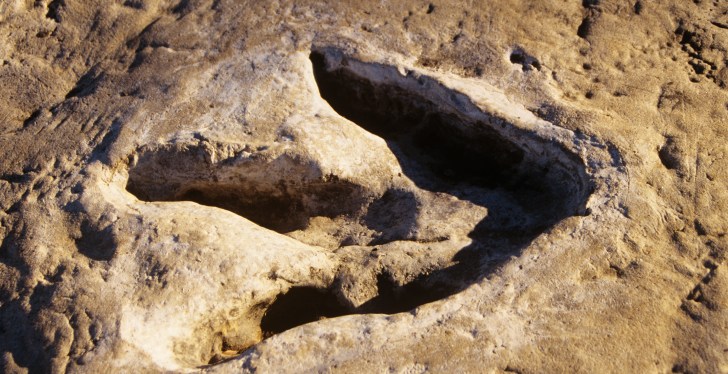
Devastating floods have swept across the Texas Hill Country landscape, claiming more than 130 lives. In the wake of the destruction, it appears that some amazing examples of dinosaur footprints have been uncovered.
A total of 15 dinosaur footprints have been uncovered by the Texas floods. They have been left by a huge animal, and are perfectly preserved in the soft and sandy earth they were originally printed. “The tracks that are unambiguously dinosaur were left by meat-eating dinosaurs similar to Acrocanthosaurus, a roughly 35-foot-long bipedal carnivore,” Matthew Brown, a paleontologist with the Jackson School Museum of Earth History at the University of Texas at Austin, remarked.
The tracks are truly ancient, with experts predicting that they are between 110 to 115 million years old. Pictures from the newly uncovered dinosaur footprints show that they are significantly bigger than a man’s foot. They measure around 18 to 20 inches.
The flooding in Texas may have uncovered more dinosaur footprints around the area, too. For a footprint to be preserved for so long, the conditions need to be ideal. The soft, but not too soft, earth in the area was perfect. The prints will have been pressed into the earth, quickly baked by the sun, and then covered by something light, such as silt or sand.
Possibly More Dinosaur Footprints In Texas
The big clean-up is underway after the floods, but experts suspect there could be more prints revealed by the destruction. They have asked construction crews and rescue efforts to take special care when using heavy machinery.
“We’ve been talking with the environmental monitoring company too about sensitive locations that they’ve gotten from the state and what to watch out for … basically, to make sure that they’re not rolling heavy equipment across the trackways,” Brown said.
The whole area is a hotspot for dinosaur relics, giving paleontologists a lot to search for. These dinosaur prints are an amazing insight into the creatures that roamed the land hundreds of millions of years ago.
It’s thanks to the floods that we now get to see what once lived in the Americas.